
There is a size where the television stops. Push past it and the picture falls apart, the price runs wild, and the format simply runs out of road. For years that was the end of the conversation. If you wanted bigger, you went to projection, and you accepted a dark room and a compromise.
And the picture is only half the problem. A very large television is a single, fragile, all-or-nothing object. Too big to handle. Too costly to repair, because when one part fails you replace the whole panel. And absurdly expensive to move: a hundred-inch screen is built in one piece, shipped to a distribution centre, then to a retailer, then to the home, every leg more expensive and more fragile than the last, with breakages counted into the price. Past seventy or eighty inches, the television starts to buckle under its own size.
Direct-view LED does not have that problem, because it is modular. It arrives as small panels and is assembled on site into one wall. If something fails, you swap a panel, not the screen. It ships in manageable pieces. It scales to whatever size the wall allows. The very things that break the television, size, weight, fragility, shipping, are the things LED was built to beat.
That ceiling has been lifted. Direct-view LED, the technology behind the giant screens in stadiums and lobbies, is coming home. And it is one of the clearest growth stories in the premium home right now.
The price curve did the work
Not long ago a wall-sized LED screen was a quarter of a million euros, and it lived in commercial buildings. That number has fallen off a cliff. Industry surveys now describe 150-inch video walls arriving at a fraction of the old cost, and integrators report large-format screens growing faster than any other video category, up for the majority and down for essentially no one.
Price curves like that do not reverse. When a technology gets dramatically cheaper and dramatically better at the same time, it does not stay in the niche it came from. It moves. LED is moving out of the arena and into the home, and it is moving quickly. This is not a someday story. It is the story the whole industry is telling this season.
Where it belongs, and where it does not
Here is the part that matters, and where a lot of the industry will get it wrong.
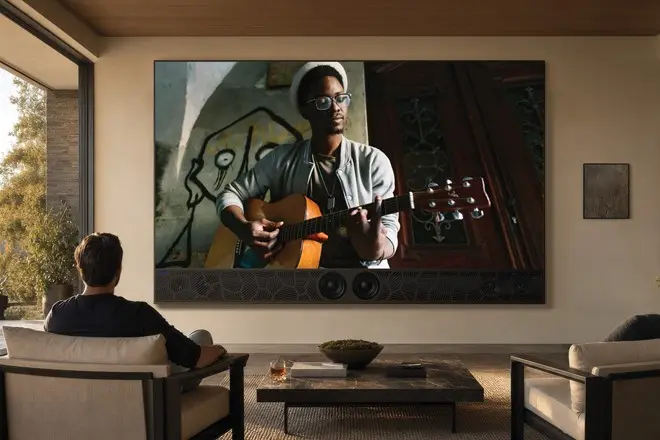
This is not about trophy cinemas. The six-figure dedicated black-box theatre is a tiny, specialist world. The CE Pro data says as much: more than nine in ten big-room installs are now multipurpose spaces, and the dedicated theatre is in decline. The real opportunity is the rooms people actually live in: the living room, the media room, the flexible cinema space that also hosts a match, a concert, the family on a Sunday.
And these are exactly the rooms where projection was always the wrong tool. A living space is an ambient-light environment, curtains open, life happening, sun coming in. Projection needs the dark to work, and these rooms are never dark. LED does not care. It is bright enough to look magnificent with daylight pouring in. That, more than anything, is why LED and not projection is the screen for the rooms we really use.
A big, brilliant LED screen changes such a room completely, and it is reachable now at sensible project sizes, delivered as a designed bundle rather than a trophy build. The point of LED coming home is not to build a handful of temples. It is to bring cinema-grade image into everyday premium living, beautifully.
Why this is pure professional work
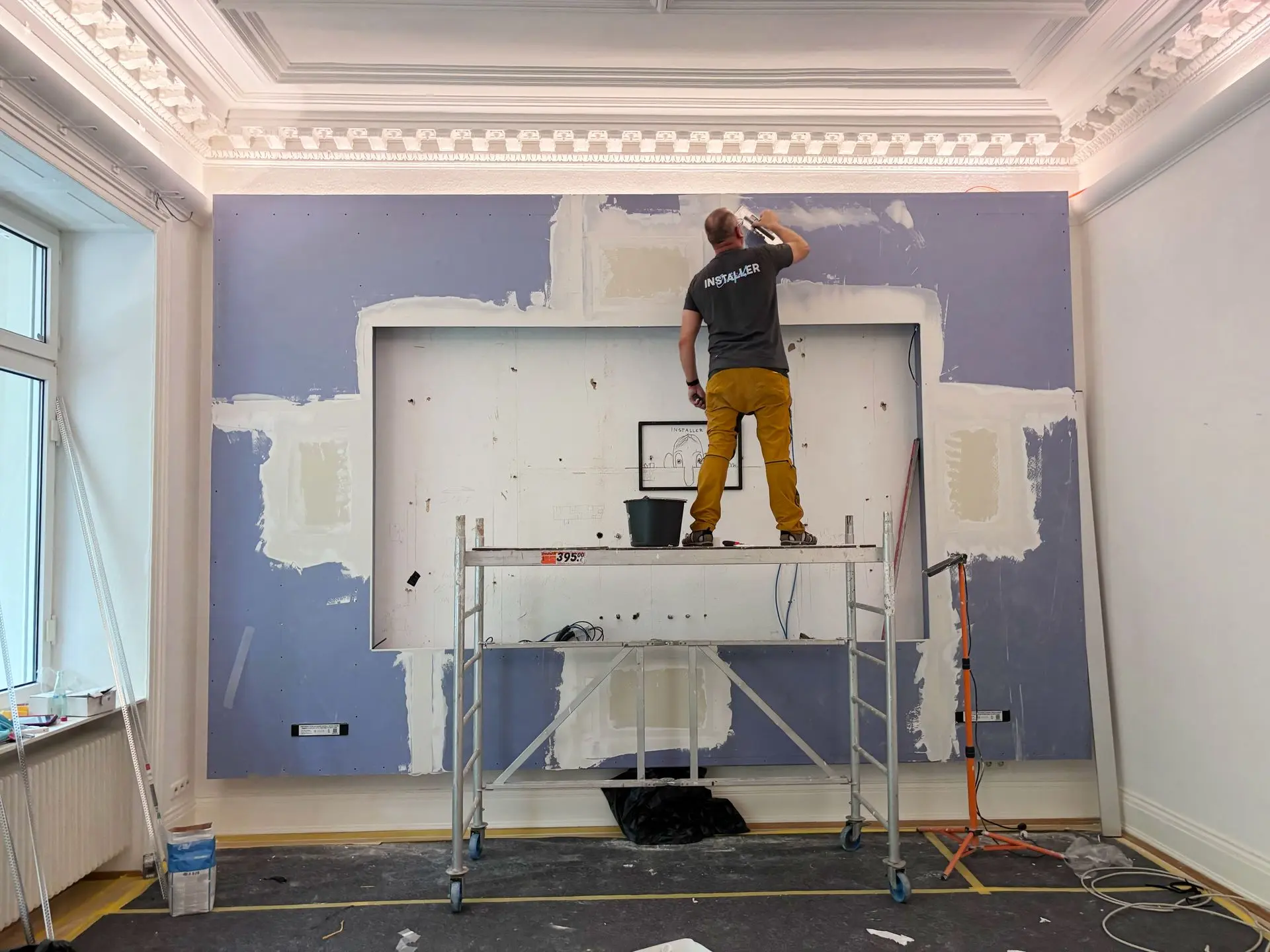
A television is a product. You buy it, you unbox it, two people hang it. A direct-view LED screen is not a product. It is a system that is delivered, built and calibrated on site.
It arrives in panels that are assembled into one seamless wall. It has to be planned into the architecture before the room is finished, powered and ventilated correctly, and calibrated so the whole surface reads as one flawless image. None of that comes in a box. All of it is designed early, by someone who knows what they are doing.
And it does not stand alone. A screen this size demands sound to match, hidden in the wall or built beautifully into the room, because a slim wall of light was never going to carry the audio. It demands light and shade that behave around it. One screen becomes one room: image, sound, light and shade, designed as a single experience.
The lesson from the television
The box was never where the money was. The value is in everything the screen sets in motion, and LED makes that plainer than any product before it, because there is barely a "box" to sell at all. There is only the system, the design, and the craft of making a wall of light disappear into a beautiful room.
A television is something a client can buy. A wall of light in the right room is something a professional builds. That is the whole difference, and it is the difference between a shrinking margin and a growing one.
The point
The television has a ceiling. LED does not. The screen is about to get bigger, brighter and more immersive than most people imagine, and it is heading straight into the rooms families actually use.
The homes that get it right will not be the ones that bought the biggest panel. They will be the ones where someone designed the whole room around it, so the technology vanishes and only the experience is left.
Let's make WOW the standard. Together.